 Add to Chrome
 Add to Firefox
 Add to Edge
OmniOPD: Logit-Free On-Policy Distillation via Speculative Verification
May 31, 2026
On-Policy Distillation (OPD) trains a student model on its own generative trajectories under dense token-level feedback from a stronger teacher, mitigating both the off-policy distribution shift of Supervised Fine-Tuning (SFT) and the sparse credit assignment of Reinforcement Learning (RL). However, standard OPD faces two coupled limitations. First, it requires direct access to the teacher's token-level logits, excluding a broad class of capable proprietary models from serving as teachers. Second, the token-level logit signal itself is brittle, depending on a narrow overlap of plausible next tokens between teacher and student, and prone to amplifying degenerate patterns such as repetition loops. In this paper, we introduce OmniOPD, a novel framework that addresses both limitations through a logit-free, chunk-level supervision signal. OmniOPD replaces deterministic logit matching with Monte Carlo rollouts that approximate the teacher's local preferences through a continuous semantic similarity metric over multi-token chunks, and concentrates this supervision via a peak-entropy scheduler that audits the student only at its high-uncertainty reasoning forks. A Dirichlet-Multinomial Bayesian prior and a base-model KL anchor further bound the variance of discrete sampling and prevent policy collapse across unaudited tokens. Across competitive benchmarks, OmniOPD surpasses the standard OPD approach by up to +28.64% on math, confirming that chunk-level semantic verification extracts a more reliable learning signal than token-level logit matching, whose high information density is offset by significant noise and brittleness. Furthermore, when paired with stronger black-box teachers such as Claude-4.5-Haiku and Gemini-2.5-Flash, OmniOPD achieves an additional +9.54% relative on math over its open-weight teacher counterpart, advancing the student past the performance of self-exploratory RL.

Self-Policy Distillation via Capability-Selective Subspace Projection
May 21, 2026Self-distillation bootstraps large language models (LLMs) by training on their own generations. However, existing methods either rely on external signals to curate self-generated outputs (e.g., correctness filtering, execution feedback, and reward search), which are costly and unavailable for the best-performing frontier models, or skip curation entirely and train on all raw outputs, an approach that is often domain-specific and hard to generalize. Both also share a deeper weakness that self-generated outputs entangle task-relevant capability with others, such as stylistic patterns, formatting artifacts, and model-specific errors, diluting the signal for the specific capability one aims to improve. In this paper, we propose Self-Policy Distillation (SPD), which achieves generalizable, capability selective without any external signal. Specifically, SPD extracts a low-rank capability subspace from the model's own gradients on correctness-defining tokens, projects key-value (KV) activations into this subspace during self-generation, and fine-tunes on the resulting raw outputs with standard next-token prediction loss. Through extensive experiments across code generation, mathematical reasoning, and multiple-choice QA, we show that SPD achieves up to 13% improvement over state-of-the-art self-distillation methods without external signals and up to 16% improvement over pre-trained baselines. Notably, SPD demonstrates superior generalizability, achieving 15% better performance under out-of-domain generalization settings.
Agentic Recommender System with Hierarchical Belief-State Memory
May 14, 2026Memory-augmented LLM agents have advanced personalized recommendation, yet existing approaches universally adopt flat memory representations that conflate ephemeral signals with stable preferences, and none provides a complete lifecycle governing how memory should evolve. We propose MARS (Memory-Augmented Agentic Recommender System), a framework that treats recommendation as a partially observable problem and maintains a structured belief state that progressively abstracts noisy behavioral observations into a compact estimate of user preferences. MARS organizes this belief state into three tiers: event memory buffers raw signals, preference memory maintains fine-grained mutable chunks with explicit strength and evidence tracking, and profile memory distills all preferences into a coherent natural language narrative. A complete lifecycle of six operations -- extraction, reinforcement, weakening, consolidation, forgetting, and resynthesis -- is adaptively scheduled by an LLM-based planner rather than fixed-interval heuristics. Experiments on four InstructRec benchmark domains show that \ours achieves state-of-the-art performance with average improvements of 26.4% in HR@1 and 10.3% in NDCG@10 over the strongest baselines with further gains from agentic scheduling in evolving settings.
Synthetic Sandbox for Training Machine Learning Engineering Agents
Apr 06, 2026As large language model agents advance beyond software engineering (SWE) tasks toward machine learning engineering (MLE), verifying agent behavior becomes orders of magnitude more expensive: while SWE tasks can be verified via fast-executing unit tests, MLE verification requires running full ML pipelines -- data preprocessing, model training, and metric evaluation -- on large datasets at each rollout step, rendering trajectory-wise on-policy reinforcement learning (RL) prohibitively slow. Existing approaches retreat to supervised fine-tuning (SFT) or offline proxy rewards, sacrificing the exploration and generalization benefits of on-policy RL. We observe that sandbox data size is the primary source of this bottleneck. Based on this insight, we introduce SandMLE, a multi-agent framework that generates diverse, verifiable synthetic MLE environments from a small number of seed tasks, preserving the structural and technical complexity of real-world problems while constraining datasets to micro-scale (each task is paired with only 50-200 training samples). Through extensive experiments, we show that SandMLE reduces execution time by over 13 times, enabling large-scale, on-policy trajectory-wise RL for the first time in the MLE domain. On MLE-bench-lite, SandMLE yields significant gains over SFT baselines across Qwen3-8B, 14B, and 30B-A3B, with relative medal rate improvements ranging from 20.3% to 66.9%. Furthermore, the trained policy generalizes across unseen agentic scaffolds, achieving up to 32.4% better HumanRank score on MLE-Dojo.
LLM-Driven Reasoning for Constraint-Aware Feature Selection in Industrial Systems
Mar 26, 2026Feature selection is a crucial step in large-scale industrial machine learning systems, directly affecting model accuracy, efficiency, and maintainability. Traditional feature selection methods rely on labeled data and statistical heuristics, making them difficult to apply in production environments where labeled data are limited and multiple operational constraints must be satisfied. To address this, we propose Model Feature Agent (MoFA), a model-driven framework that performs sequential, reasoning-based feature selection using both semantic and quantitative feature information. MoFA incorporates feature definitions, importance scores, correlations, and metadata (e.g., feature groups or types) into structured prompts and selects features through interpretable, constraint-aware reasoning. We evaluate MoFA in three real-world industrial applications: (1) True Interest and Time-Worthiness Prediction, where it improves accuracy while reducing feature group complexity, (2) Value Model Enhancement, where it discovers high-order interaction terms that yield substantial engagement gains in online experiments, and (3) Notification Behavior Prediction, where it selects compact, high-value feature subsets that improve both model accuracy and inference efficiency. Together, these results demonstrate the practicality and effectiveness of LLM-based reasoning for feature selection in real production systems.
TARo: Token-level Adaptive Routing for LLM Test-time Alignment
Mar 19, 2026Large language models (LLMs) exhibit strong reasoning capabilities but typically require expensive post-training to reach high performance. Recent test-time alignment methods offer a lightweight alternative, but have been explored mainly for preference alignment rather than reasoning. To bridge this gap, we propose, Token-level Adaptive Routing (TARo), which steers frozen LLMs toward structured reasoning entirely at inference time. Specifically, we first train reward models on step-wise mathematical traces to capture fine-grained logical consistency signals, then introduce a learnable token-level router that automatically controls the guidance of the reward model to the base model. Extensive experiments show that TARo significantly improves reasoning performance by up to +22.4% over base model and +8.4% over existing token-level test-time alignment methods, while also boosting out-of-distribution clinical reasoning (MedXpertQA) and instruction following (AlpacaEval). Furthermore, TARo also generalizes from small to large backbones without retraining, extending test-time alignment from preference optimization to robust, cross-domain reasoning.
Accelerating PDE Surrogates via RL-Guided Mesh Optimization
Mar 02, 2026Deep surrogate models for parametric partial differential equations (PDEs) can deliver high-fidelity approximations but remain prohibitively data-hungry: training often requires thousands of fine-grid simulations, each incurring substantial computational cost. To address this challenge, we introduce RLMesh, an end-to-end framework for efficient surrogate training under limited simulation budget. The key idea is to use reinforcement learning (RL) to adaptively allocate mesh grid points non-uniformly within each simulation domain, focusing numerical resolution in regions most critical for accurate PDE solutions. A lightweight proxy model further accelerates RL training by providing efficient reward estimates without full surrogate retraining. Experiments on PDE benchmarks demonstrate that RLMesh achieves competitive accuracy to baselines but with substantially fewer simulation queries. These results show that solver-level spatial adaptivity can dramatically improve the efficiency of surrogate training pipelines, enabling practical deployment of learning-based PDE surrogates across a wide range of problems.
Token-Level LLM Collaboration via FusionRoute
Jan 08, 2026Large language models (LLMs) exhibit strengths across diverse domains. However, achieving strong performance across these domains with a single general-purpose model typically requires scaling to sizes that are prohibitively expensive to train and deploy. On the other hand, while smaller domain-specialized models are much more efficient, they struggle to generalize beyond their training distributions. To address this dilemma, we propose FusionRoute, a robust and effective token-level multi-LLM collaboration framework in which a lightweight router simultaneously (i) selects the most suitable expert at each decoding step and (ii) contributes a complementary logit that refines or corrects the selected expert's next-token distribution via logit addition. Unlike existing token-level collaboration methods that rely solely on fixed expert outputs, we provide a theoretical analysis showing that pure expert-only routing is fundamentally limited: unless strong global coverage assumptions hold, it cannot in general realize the optimal decoding policy. By augmenting expert selection with a trainable complementary generator, FusionRoute expands the effective policy class and enables recovery of optimal value functions under mild conditions. Empirically, across both Llama-3 and Gemma-2 families and diverse benchmarks spanning mathematical reasoning, code generation, and instruction following, FusionRoute outperforms both sequence- and token-level collaboration, model merging, and direct fine-tuning, while remaining competitive with domain experts on their respective tasks.
Scaling Agent Learning via Experience Synthesis
Nov 10, 2025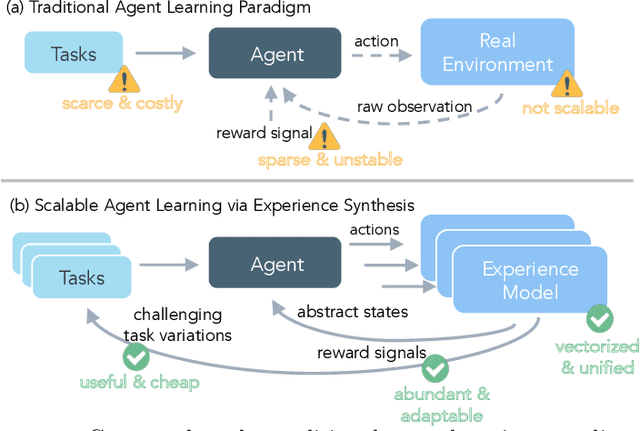
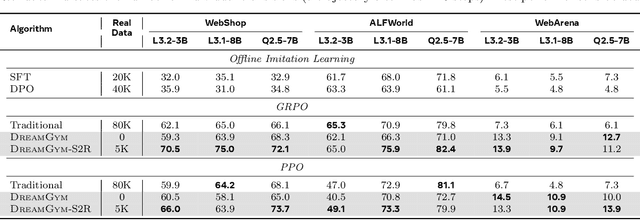
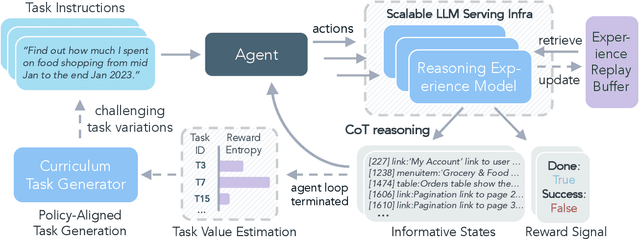
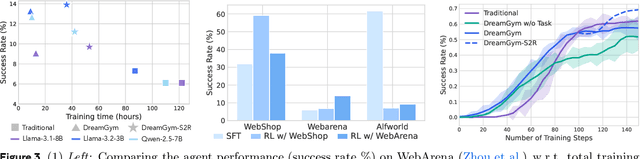
While reinforcement learning (RL) can empower autonomous agents by enabling self-improvement through interaction, its practical adoption remains challenging due to costly rollouts, limited task diversity, unreliable reward signals, and infrastructure complexity, all of which obstruct the collection of scalable experience data. To address these challenges, we introduce DreamGym, the first unified framework designed to synthesize diverse experiences with scalability in mind to enable effective online RL training for autonomous agents. Rather than relying on expensive real-environment rollouts, DreamGym distills environment dynamics into a reasoning-based experience model that derives consistent state transitions and feedback signals through step-by-step reasoning, enabling scalable agent rollout collection for RL. To improve the stability and quality of transitions, DreamGym leverages an experience replay buffer initialized with offline real-world data and continuously enriched with fresh interactions to actively support agent training. To improve knowledge acquisition, DreamGym adaptively generates new tasks that challenge the current agent policy, enabling more effective online curriculum learning. Experiments across diverse environments and agent backbones demonstrate that DreamGym substantially improves RL training, both in fully synthetic settings and in sim-to-real transfer scenarios. On non-RL-ready tasks like WebArena, DreamGym outperforms all baselines by over 30%. And in RL-ready but costly settings, it matches GRPO and PPO performance using only synthetic interactions. When transferring a policy trained purely on synthetic experiences to real-environment RL, DreamGym yields significant additional performance gains while requiring far fewer real-world interactions, providing a scalable warm-start strategy for general-purpose RL.
Thought Communication in Multiagent Collaboration
Oct 23, 2025Natural language has long enabled human cooperation, but its lossy, ambiguous, and indirect nature limits the potential of collective intelligence. While machines are not subject to these constraints, most LLM-based multi-agent systems still rely solely on natural language, exchanging tokens or their embeddings. To go beyond language, we introduce a new paradigm, thought communication, which enables agents to interact directly mind-to-mind, akin to telepathy. To uncover these latent thoughts in a principled way, we formalize the process as a general latent variable model, where agent states are generated by an unknown function of underlying thoughts. We prove that, in a nonparametric setting without auxiliary information, both shared and private latent thoughts between any pair of agents can be identified. Moreover, the global structure of thought sharing, including which agents share which thoughts and how these relationships are structured, can also be recovered with theoretical guarantees. Guided by the established theory, we develop a framework that extracts latent thoughts from all agents prior to communication and assigns each agent the relevant thoughts, along with their sharing patterns. This paradigm naturally extends beyond LLMs to all modalities, as most observational data arise from hidden generative processes. Experiments on both synthetic and real-world benchmarks validate the theory and demonstrate the collaborative advantages of thought communication. We hope this work illuminates the potential of leveraging the hidden world, as many challenges remain unsolvable through surface-level observation alone, regardless of compute or data scale.